MEXICO TO THE MARQUESAS: And the Intertropical Convergence Zone
By Cheryle Matthew
Reprinted from SisterShip Magazine
June 2019
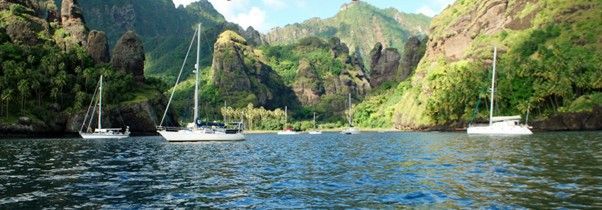
We crossed the Pacific for the first time in 2009 on our previous yacht Sea Dove, a Savage Oceanic 42. The weather was glorious for the whole trip, and we were spoiled with 15-20 knot trade winds, sunshine, and blue skies. The toughest part of the trip was deciding which book to read next and what lure to put on the fishing line. However, our trip was cut short as we had to race home for family reasons.
We rushed through the Pacific in less than three months on that first trip and sold Sea Dove as family commitments dominated our life for the next few years, but that is a story best left for another time. We later bought Sea Nymph in Los Angeles with the intention of sailing the South Pacific again.
Had we tempted fate? Should we have been satisfied with our first dream run?
This second crossing was as different as chalk and cheese. We left from the Northern Hemisphere this time and had to cross the intertropical convergence zone (ITCZ) to reach the Southern Hemisphere. We left the Mexican coast at Cabo San Lucas on a southwest heading to 10 degrees north where we had planned to cross the ITCZ at right angles and then set a course to the Marquesas Islands.
The ITCZ, known by sailors as the doldrums or the calms, is a band of unsettled weather encircling the earth where the northeast and southeast trade winds converge. This band of disturbed weather moves and meanders along the equator and can vary as much as 120 miles in a 24-hour period. The weather patterns in the ITCZ can form and dissipate in less than 24 hours. Seas are usually moderate-to-small but can be confused since they can come from any direction or several directions at once. The area is characterised by doldrums, squalls, and torrential rain. Conditions change regularly and the best laid plans can go astray with the changing weather patterns. Sounds terrific, doesn't it?
Leaving Cabo San Lucas and the Mexican coast our plan was to remain north of the ITCZ for as long as possible. Our course mimicked the shape of a giant squashed letter S. We wanted to make the most of the northeast trades and the further west we travelled the thinner the band of ITCZ would be. Here we would cross into the southern latitudes and pick up the southeast trades. We had been talking to three other yachts on the radio in the Sea of Cortez as we made our way from La Paz to Cabo San Lucas and agreed to stay in radio communication for as long as we could. Sea Nymph didn’t have a HF radio and due to the added expense of buying and installing one, we opted to purchase a Satellite phone instead for weather reports that we would download to our laptop along with emails using the MailASail program. This meant we wouldn’t be able to join in the HF Community Radio Sched which would keep us in radio contact with sailors on the same route. Once we were 20-30 miles away from them, we would lose our VHF signal.
We left Cabo San Lucas and the Mexican coast with southwest winds. Our first two days and nights out were most uncomfortable with confused seas due to the cape effect, and the wind was on the nose. As we hadn’t been out in the ocean for some time, we were both feeling a bit under the weather and exhausted so on the second night we hove-to for six hours and felt much better for the rest and three hours sleep each. We then picked up the northeast trades on April 30th and the entire scene changed. It was superb trade wind sailing with the mainsail out and a poled headsail as we cruised along nicely at around six knots. Bruce and I are conservative sailors, and we generally reef our main at night and furl the head sail a little depending on the conditions. We feel it best to reef when it’s still day light rather than having to do it with increased weather conditions in the middle of the night. For the next week the sailing conditions were terrific, we made good mileage each day and our spirits soared as our bodies adjusted to the movement of the boat and we found comfort in the routine of long-distance passage making.
About a week out from land, we were joined by up to six large booby birds. They were constantly trying to land on the boat. If they had been content to sit on the deck or railings that would have been fine, but they were determined to land on the top of the mast with all our masthead instruments and antennae. The numbers increased on dusk, all desperately seeking a perch for the night. We shone the spotlight on them and sounded the foghorn to scare them off. This went on for at least an hour every evening for about a week. Occasionally they would try at night but would fall off the spreaders or the radar dome as the yacht rolled. Our concern was suffering damage to the mast head instruments including the VHF antenna, wind speed instruments, or navigation lights. After a week they gave up and disappeared as quickly as they had first appeared.
About 10 days into the passage, we noticed the weather pattern changing. As we sailed west above the ITCZ we saw clouds forming south of us, they were only about five or six miles away and were as black and ominous as imaginable. If they’d stayed put it wouldn’t have been an issue, but they would irregularly move north and give us a thorough drenching. As we neared the position 10 degrees north and 130 degrees west, where we intended to cross the ITCZ, we looked for a gap in the weather and black clouds, decided that there wasn’t going to be any reprieve, took a deep breath and turned south to cross the zone.
I wasn’t looking forward to crossing this particular part of ocean, perhaps I had done too much reading preparation. I was quite concerned; was our new little yacht up to the task? She was far livelier than our previous yachts and this would be the test. We found a problem in the canvas spray dodger; it leaked like a sieve. We smothered it in water repellent spray, but it didn’t last long. It was going to be a wet trip; luckily it was warm.
On the second day into the crossing of the zone 20 pilot whales came to greet us, keeping us company for at least half an hour. We could hear their high pitch whistling noise as they communicated with each other, and perhaps with us. They were about twice the length of a dolphin and looked quite dolphin-like but without the beak. It was exhilarating, and at times breathtaking, as they seemed to play a game of tag with us. They would swim in a circular pattern, coming in smaller groups of five-to-ten swimming about 100 metres behind the boat, then race up to the stern, stop short for a moment then swim down the side of the hull, disappearing only to reappear behind us again. They were coming so close to the windvane that we started to worry they might break it. Just as we were discussing taking it out of the water to be on the safe side, one of the pilot whales did something almost unbelievable. It was a whale with a very noticeable jagged fin, the biggest of the pod, and perhaps the leader. He rushed up with the next group in the tag game and stopped just behind the paddle, which was moving from side to side like a metronome. As we were watching we held our breath as the whale paused only five inches from the paddle and waited a moment watching it, then amazingly he moved his body and nudged the paddle sideways in time with the regular movement of the windvane paddle. That was it, Bruce yelled, and we quickly pulled the paddle out of the water before the pilot whale decided to play with it again.
We sailed for three days through typical ITCZ weather, watching as huge black clouds formed to surround us. Hoping to avoid another drenching we used the radar to aim for the thinnest band of bad weather, changing direction if the clouds looked particularly threatening or if the radar showed them to be large areas of bad weather. When in doldrums we motored and recharged our batteries. One day followed the next, we dodged storms, cooked, read books, and I played with my iPad and Navionics charting program. This was our backup chart plotter and I love it.
We crossed the ITCZ and were welcomed by a rainbow.
This was the first ocean crossing we had made in Sea Nymph and she proved herself a capable bluewater passage maker. My faith in her had grown immensely. Although the ITCZ was hard work, it wasn’t as terrifying as I had expected, we found it just wet and gloomy with frequent squalls to keep us on our toes. The waves weren’t huge, just confused. Our water tanks were topped up with rainwater, all our clothes were washed, and we had the most wonderful experience with pilot whales that I could have wished for, so the ITCZ had some positive outcomes.
Would I do it again? Yes, for sure, but next time I’d like a solid waterproof spray dodger and a dry cockpit.
CHERYLE MATTHEW is a registered nurse. She and her husband Bruce spent nine and a half years circumnavigating the globe. They had regular trips back home to work and top up their sailing kitty and to spend time with their five children and ever increasing number of grandchildren. Cheryle and Bruce have sailed over 80,000 nm together.